
Just a brief caveat on the pronoun usage for this article – I have almost exclusively used the pronoun “he” when referring to a singular person. This is just a literary tool to cut down on word count and smooth out the flow. In context, I’ve used “he” as a descriptor for “generic adult human” – there’s no offense intended, and I hope none is taken. Thanks!
Hi, friends! If you’re familiar with Guardienne Solutions, you know that we offer instruction and coaching for personal defense. If you aren’t yet familiar with us – WELCOME! Our classes range from non-lethal (decision making), less-than-lethal (OC spray), to lethal (firearms instruction). As firearms instructors, we are in the business of teaching the skillful, precise, and ethical application of violence to anyone with the means, ability, and desire to acquire said skill. Unfortunately, teaching skill-at-arms is where many instructors STOP. Why? Because it’s easy to teach mechanical skills (the HOW), and it’s difficult to have meaningful philosophical discussions about use of deadly force (the WHY, the WHEN, and the WHAT HAPPENS NEXT).
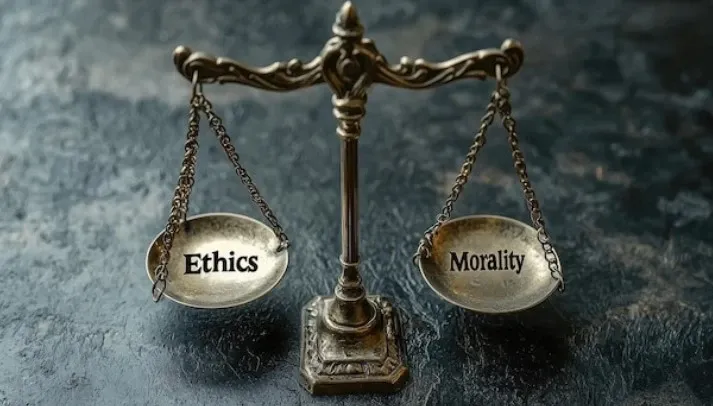
A brief differentiation between the terms “morals” and “ethics” is necessary before we apply those terms to the application of violence. Broadly stated, morals are personal and will vary accordingly. What one person sees as moral, another will not. This has to do with preconceived and culturally promoted notions of what is good for a society, and what is not. However, what is good for a society is not necessarily seen as good on an individual scale. Therefore, morals, morality, and moral judgements are internal decisions based on individual biases and notions of goodness.
Ethics, however, can be broadly described as a set of rules of enforced politeness that are generally agreed upon by a society. The Law (big L) can be ethical while it ignores morality. For example, forcible rape is generally seen in the United States to be a very bad thing, and there are laws designed to cage or kill those who engage in it. The application of said laws is ethical because we have collectively agreed to the rules. The rapist, however, has a moral code that justifies his activities, if only to himself.
Ethics and morals can often exist in opposition to one another, as evidenced by the practice of slavery. In some societies (yes, even so-called modern societies), slavery is an ethical practice because it is tolerated by the Law – even though it is morally repugnant to the enslaved as well as to the witness. When individual moral outrage over a practice becomes societal, we often see violence used as a means to change previously ethical practices; such was the case with the Civil War in the United States. In his bid to keep the United States whole, Lincoln juxtaposed the “ethical” practice of slavery against the abattoir of morality required to justify owning another human being. In this instance, we see violence (i. e. war) justified as a moral imperative, rather than an ethical one.
When discussing use of deadly force, we also need to differentiate between individual use of force, and force employed by the State. “The State calls its own violence law, but that of the individual crime.” Max Stirner’s words are close, but not quite right for the purposes of our discussion. Much of the violence or force employed by the State is implicit; Follow the Law or men with guns will arrive to cage or kill you. In most instances, the State reserves the use of deadly force for itself; there are, however, limited circumstances where use of deadly force by an individual is permissible under the law (ethical, as it were).
The ethical use of deadly force by an individual is where many firearms instructors end the discussion. In short, “You CAN kill someone in certain circumstances, and this is HOW you do it.” This approach is both shortsighted and irresponsible. It ignores the price that will be paid for taking a life. There will be a reckoning; said reckoning will be legal, financial, social, emotional, and spiritual. This is where a clearly defined set of morals or a moral code becomes crucial. A good instructor (be it firearms, martial arts, or any other deadly skill) will ensure that his student is able to build that code.
Kant had a useful take on the morality of violence (if I remember correctly). Basically, human beings are capable of rational thought and empirical reasoning. As such, a rational human can make decisions on the moral use of violence via reasoning: if a murderer is operating in society, the moral good of killing the murderer outweighs the moral bad of being a killer. In a self-defense scenario, the moral good of preserving your life outweighs the moral bad of taking the life of another. The use of pre-emptive violence can become morally ambiguous, however. For example, if you recognize pre-assault indicators and decide to strike first, thereby preventing great harm to yourself or another by not allowing a bad actor to act, have you acted ethically and morally? It’s hard to say. This is the dilemma that a teacher should present to the student, so that the student can decide for himself where that personal, moral line resides.
If the only thing a student learns is that he can use violence because it’s ethical, he will invariably make a terrible moral choice. In order to prevent that, a good teacher will provide a student with options – ways to avoid making that choice, ways to minimize the damage if the choice becomes necessary, and ways to live with the result if he has no other choice.
So, if morals are personal and individual, how does an instructor guide a student to making moral as well as ethical decisions, without enforcing his own moral code on the learner? And how does the instructor do that in eight hours or less? Short answer – we don’t know. But Courtney and I try our best to present dilemmas during coaching that do NOT have an easily quantifiable answer.
We can definitely teach you the HOW for personal defense. We can explain the circumstances under which you CAN use force to defend yourself or others. Those are easy. But the WHY, the WHEN, and how to survive the WHAT HAPPENS NEXT? We can’t really teach that. We can present the dilemma for you to think about (and we do).
YOU have to decide those things for yourself. What’s your hard boundary? What’s your “this far, no further” line that can’t be crossed? “This far, no further” applies equally to what you will allow to be done to you, and what you are willing to do to another. (It’s also a great Star Trek quote.) Those are moral decisions and are intensely personal. YOU decide what you will allow. YOU decide what level of force you’re willing to use. YOU decide why you’re willing or unwilling to use said force. YOU decide when the go-signal begins. And, ultimately, YOU will have to decide how to survive what comes next.
This is what happens when your business partner is a mental health therapist – you get the hard lessons for free – ha! Call your girls if you want to learn more about being harder to victimize – we’re here for you! Stay safer, be tougher, and live your VERY best life. Until next time. And drink your water!